
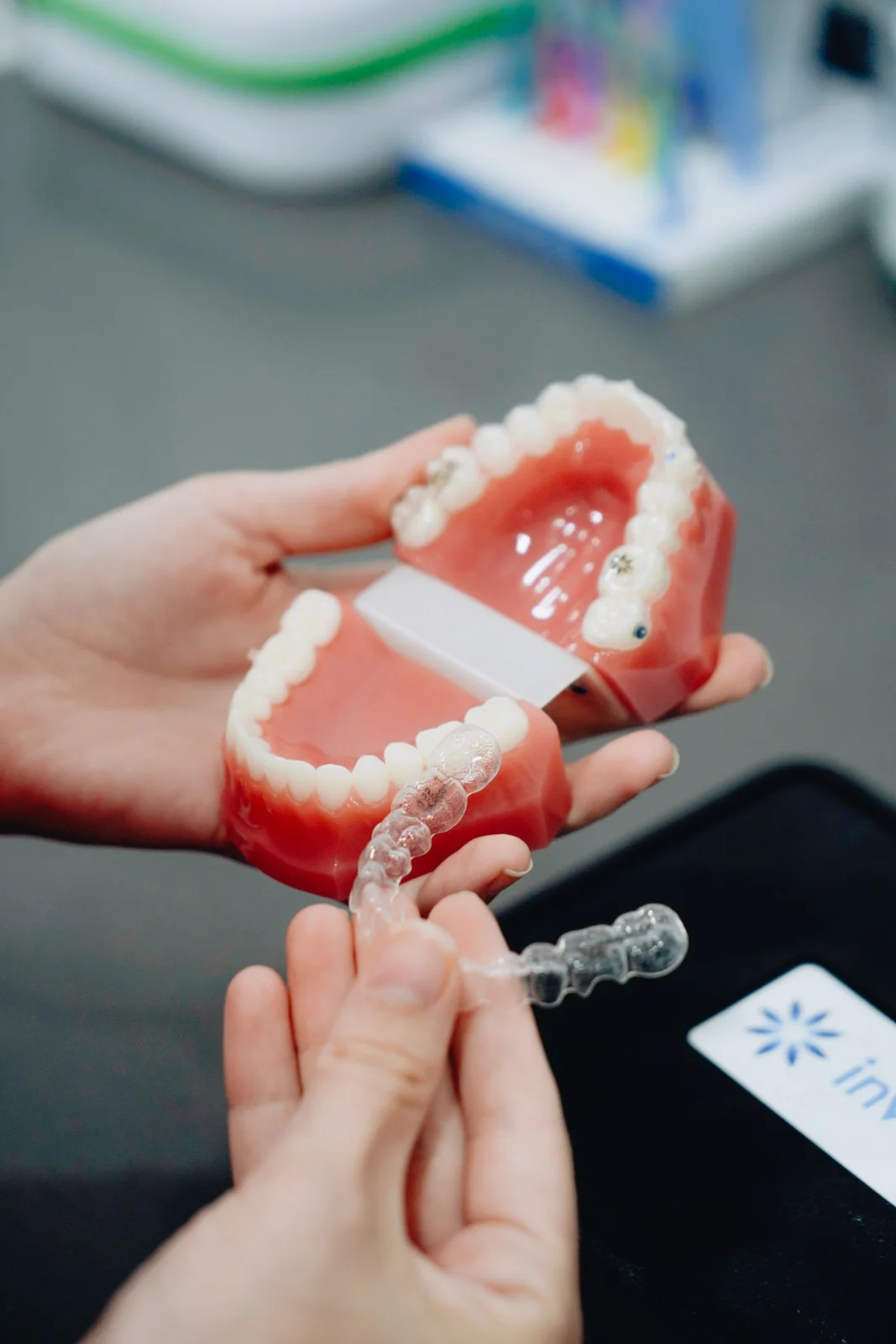
Stock photograph for illustration; not a participating clinic, practitioner, patient or treatment result. Photo: Beyza Kaplan / Pexels.
When you are weighing up aligners vs braces, the most useful thing to understand early is that no website comparison can tell you which appliance suits your mouth — but arriving at a consultation with the right questions dramatically changes what you get out of that appointment. This guide explains how the main appliance categories differ in general terms, what factors a practitioner considers during an individual assessment, and how to build a comparable question list so you can evaluate proposals fairly.
The main orthodontic appliance categories
The Australian Society of Orthodontists identifies four broad categories of orthodontic appliance: metal braces, ceramic braces, lingual braces and clear aligners. Each sits under the same general goal — moving teeth and correcting bite alignment — but they differ in how they are worn and where they sit.
Metal braces use brackets bonded to the outer face of teeth connected by a wire. They are the longest-established fixed appliance and remain common for a wide range of presentations.
Ceramic braces follow the same bracket-and-wire principle but use tooth-coloured or clear ceramic material for the brackets, making them less visually prominent than metal.
Lingual braces are bonded to the inner (tongue-facing) surface of teeth, making them essentially invisible from the front. Because of their placement they require different clinical skill and are not offered by every practice.
Clear aligners are removable, clear plastic trays made to fit over the teeth. Because they are removable, compliance — meaning how consistently the person actually wears them — is a significant variable that fixed appliances do not share. A dentist or orthodontist advises individual suitability; no appliance category is universally superior.
For a deeper look at the aligner-specific side of this comparison, see our guide to clear aligner consultation questions and, if you are exploring a specific brand, Invisalign branded consultation questions or Spark aligner enquiry questions.
Why appliance type alone does not answer the question
The Australian Dental Association notes that a dentist or orthodontist advises individual suitability and that in-person assessment and supervision is recommended rather than DIY orthodontics. That position reflects the reality that treatment decisions depend on clinical findings — things like tooth positions, jaw relationships, bone structure, gum health and existing dental work — that cannot be assessed from photographs or general information.
Orthodontists are dental specialists; general dentists may also provide some orthodontic treatment. The practitioner’s scope, training and the systems they are accredited or trained to deliver will influence which options they can offer you. Checking that a named practitioner is on the Ahpra public register of dental practitioners (and, where relevant, holds specialist registration) is a straightforward step before committing to treatment.
Questions to ask about your individual assessment
Before discussing appliances, understand what the assessment itself involves. These are questions worth raising:
- What records will be taken at the assessment (photographs, X-rays, scans, models)?
- Is the assessment cost included in any subsequent treatment fee, or is it a separate charge?
- Will the same practitioner who does the assessment carry out treatment?
- If a problem arises during treatment — for example, a tooth that is not responding as expected — what does the review process look like?
- Does the practice offer all four appliance categories, or only some?
That last question matters because a practitioner who only offers one type of appliance cannot give you a neutral comparison. Asking up front about the full range they provide helps you interpret the recommendation that follows.
Comparable questions for a braces versus aligners proposal
If you are considering getting quotes or assessments from more than one practice, you need to ask the same questions at each so the proposals are actually comparable. The Australian Society of Orthodontists cost checklist identifies several areas worth confirming explicitly:
Inclusions
- Does the quoted fee include initial records (scans, X-rays, photographs)?
- Are all adjustment or progress appointments included?
- Are retainers included at the end of active treatment?
- Is there a cost for replacement retainers if one is lost or damaged?
- What follow-up period is included after active treatment ends?
Treatment specifics
- What appliance or combination of appliances is being proposed, and why?
- If aligners are proposed: how many trays are planned, and what happens if refinements are needed?
- If braces are proposed: what type of bracket and wire system is being used?
- Are there any additional appliances (such as expanders or elastics) that may be needed, and would those attract an extra cost?
Compliance and lifestyle
- For aligners specifically: what minimum daily wear is expected, and what happens clinically if that is not achieved?
- For fixed braces: what food restrictions apply, and how does that affect oral hygiene routine?
Healthdirect Australia recommends writing down your questions before an appointment and asking for explanations in plain language — particularly useful when a practitioner uses clinical terminology that is unfamiliar.
A hypothetical scenario: comparing two proposals (illustrative only)
This is a hypothetical example, not a real patient story.
Imagine someone attending two separate consultation appointments in Adelaide — one at a practice that offers only clear aligners, and one at a practice that offers the full range. The first practice quotes a single aligner fee that sounds straightforward. The second practice proposes ceramic braces with a refinement aligner phase and breaks the quote into assessment records, active treatment, retainers and two years of follow-up. Without a checklist of comparable questions, it would be easy to treat the simpler-sounding quote as the cheaper option — even if the second quote covers items the first assumes you will pay for separately later.
Using the inclusions questions above at both appointments makes the comparison meaningful rather than superficial.
Aligners vs braces cost: what the quote should itemise
Cost is often what prompts the aligners vs braces question in the first place. The truthful answer is that quoted fees vary based on the complexity of the case, the appliance system used, the practice’s location and what the quote actually includes. For a structured guide to unpacking what should appear in a written cost proposal, see our clear aligner cost quote checklist.
The key principle: a lower headline figure that excludes records, retainers and follow-up is not a lower cost — it is an incomplete comparison.
Verifying the practitioner
Before proceeding with treatment anywhere, verify the practitioner’s registration on the Ahpra public register. Search by the individual’s name rather than the business name, since registration attaches to the person. Ahpra and the National Boards maintain publicly searchable registers covering dental practitioners and specialist registration categories.
Ready to prepare for a consultation?
This site accepts consultation enquiries, with any referral subject to confirmed availability. If you are ready to take the next step, you can submit a braces consultation enquiry, request a clear aligner consultation enquiry, or if you are an adult exploring your options, see our adult orthodontic consultation enquiries page.
Further reading and sources
- Australian Society of Orthodontists, Treatment Comparison Table: https://orthodonticsaustralia.org.au/wp-content/uploads/2020/01/ASO_Treatment-Comparison_Table_A4_V24.pdf
- Australian Society of Orthodontists, Orthodontics Checklist: https://orthodonticsaustralia.org.au/wp-content/uploads/2019/11/2019-09-OA-Orthodontics-Checklist-A4-concepts_v2.pdf
- Australian Dental Association, Teeth Straightening and Braces: https://teeth.org.au/teeth-straightening-and-braces
- Healthdirect Australia, Questions to Ask Your Doctor: https://www.healthdirect.gov.au/healthcare-and-services/general-health/questions-to-ask-your-doctor
- Ahpra, Registers of Practitioners: https://www.ahpra.gov.au/Registration/Registers-of-Practitioners/Professions-and-Divisions.aspx
Sources and further reading
- Professional dental information — ASO_Treatment Comparison_Table_A4_V24.pdf
- Professional dental information — Guide%20to%20Clear%20Aligners%20Final%2029%20April%202026.pdf
- Australian Dental Association — teeth straightening and braces
- Professional dental information — 2019 09 OA Orthodontics Checklist A4 concepts_v2.pdf
- healthdirect Australia — questions to ask your doctor
- Ahpra practitioner information — Professions and Divisions.aspx
Source links provide background, not an endorsement or clinical review of this page. Read our editorial approach.