
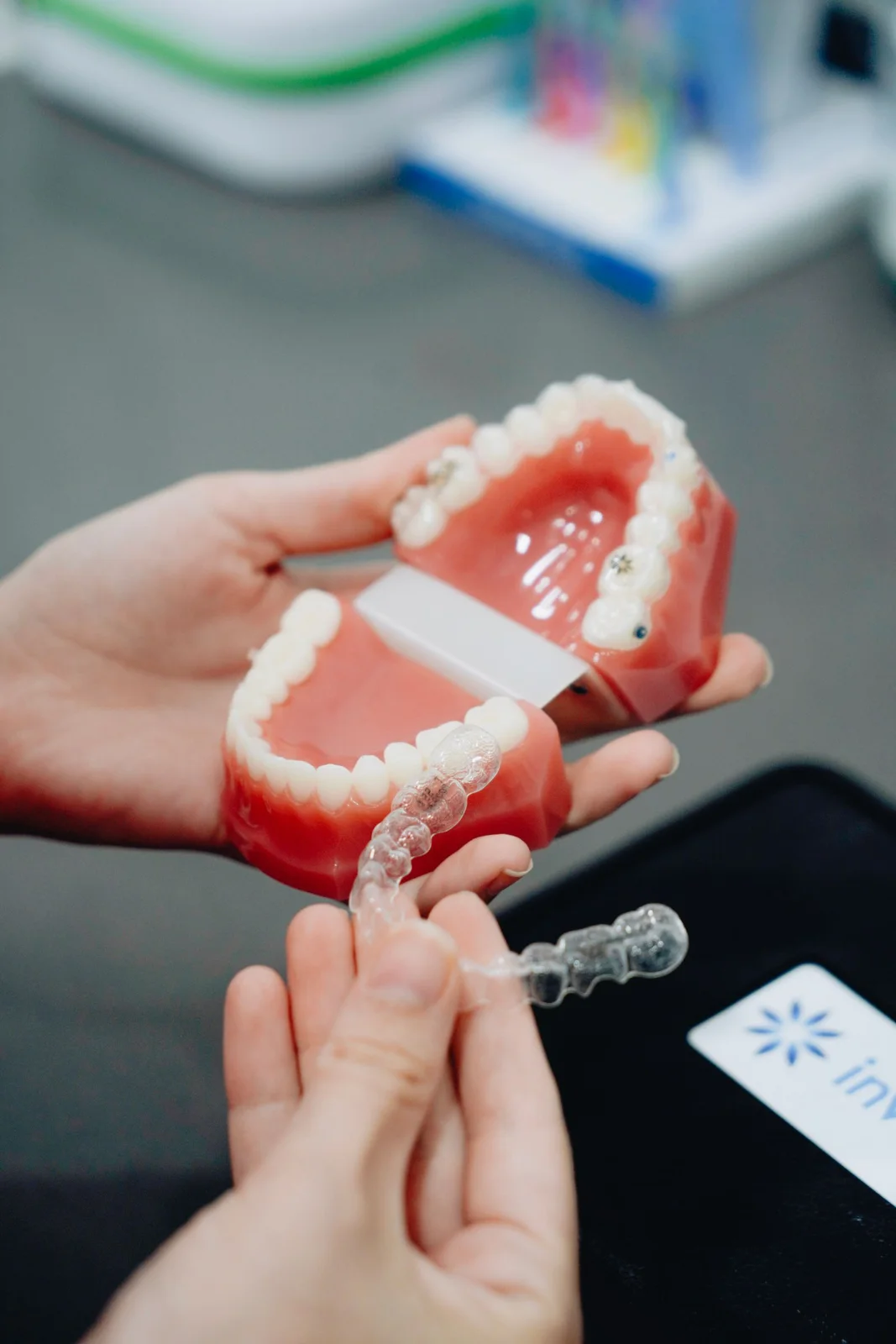
Stock photograph for illustration; not a participating clinic, practitioner, patient or treatment result. Photo: Beyza Kaplan / Pexels.
What questions should you ask at a clear aligner consultation?
A clear aligner consultation is your opportunity to understand how the appliance works, who is qualified to assess you, and what a written treatment plan should cover before you agree to anything. Walking in with prepared questions means you leave with specific answers rather than general reassurances. The sections below explain key terminology, clarify who does the assessing, and list the practical questions worth raising.
General appliance terminology worth understanding first
Clear aligners are removable, clear plastic appliances worn over the teeth to move them gradually. They sit alongside other orthodontic options — metal braces, ceramic braces and lingual braces — as recognised categories of tooth-straightening treatment.
A few terms you will hear in consultations:
- Aligner series – the full sequence of trays planned for your treatment, each slightly different from the last.
- Attachments – small tooth-coloured shapes bonded to certain teeth to help the aligner grip and apply more precise forces.
- Refinements – additional aligner sets ordered mid-treatment if tooth movement hasn’t reached the planned position.
- Retainers – appliances worn after active treatment to hold teeth in their new position. These are separate from your aligner series.
- Records – the clinical data (photographs, X-rays, scans or impressions) collected before treatment planning begins.
Knowing these words before your appointment means you can ask follow-up questions when a practitioner uses them, rather than nodding along.
Who is qualified to assess your options?
Both orthodontists and general dentists may provide clear aligner treatment in Australia. An orthodontist is a dental specialist who has completed additional postgraduate training beyond a dental degree; a general dentist with appropriate training may also offer aligner treatment. Neither role is superior in every situation — the relevant question is whether the individual practitioner is registered and experienced with the type of case you present.
The Australian Health Practitioner Regulation Agency (Ahpra) maintains a public register of dental practitioners, including which registrants hold specialist registration. It is worth checking the specific individual’s name, not just the business name, before committing to treatment.
The Australian Dental Association advises that an in-person assessment by a registered practitioner — rather than a remote or mail-order process — is the appropriate starting point for orthodontic treatment. Suitability for any appliance is a clinical judgement that belongs to the treating practitioner after they have examined you, not something a referral website can determine.
If you are unsure whether to see a general dentist or an orthodontist first, that is itself a good question to put to both and compare the answers. You can also explore adult orthodontic consultation enquiries if you want to connect with a practitioner in Adelaide.
Questions about the assessment process
Before treatment planning starts, a practitioner typically needs records — digital scans, photographs and X-rays are common. Questions to ask:
- What records will you take, and are they included in the consultation fee or quoted separately?
- How will you use those records to plan my treatment?
- Do you use a digital treatment simulation, and can I see the planned movements before I commit?
- Will I need to see any other specialist (for example, a periodontist if I have gum concerns) before treatment can begin?
Writing your questions down before you arrive helps you remember them in the moment — a straightforward habit recommended by Healthdirect Australia for any health appointment.
Written-plan questions to raise before signing
A written treatment plan is distinct from a marketing brochure. Before signing any agreement, consider asking for the following in writing:
- The clinical rationale — what tooth movements are planned and why.
- The expected number of aligners in the initial series.
- What triggers a refinement, and whether refinements are included in the quoted fee or charged separately.
- How many in-person visits are expected during active treatment.
- What happens if an aligner is lost or damaged — is replacement included?
- What retainer type is recommended, what it costs, and whether replacement retainers are included or additional.
- The total quoted fee, broken down so you can see what is and isn’t covered.
The Australian Society of Orthodontists cost checklist prompts patients to confirm whether assessment, records, appliances, visits, retainers and replacement retainers are each included in a quote. Using that framework as a mental checklist during your appointment helps you spot gaps before you are committed.
For a detailed breakdown of what a quote document should contain, see the clear aligner cost quote checklist.
Hypothetical scenario: two patients, two different consultations
The following is a hypothetical illustration, not a customer story.
Imagine two people attending separate clear aligner consultations in Adelaide on the same day. The first person goes in without prepared questions and leaves having agreed to treatment — they later discover their quote didn’t include refinements or replacement retainers. The second person brings a written list covering records fees, refinement policy, retainer type, and what happens if an aligner splits. They leave with a written breakdown they can review overnight before deciding.
Same product category, same city — meaningfully different information outcome. The list is the differentiator.
Questions specific to the aligner brand or system
Several aligner systems are available in Australia. Some questions are brand-agnostic; others are worth asking about the specific system your practitioner uses:
- Is this a branded system (such as Invisalign or Spark) or the practice’s own in-house planning?
- Who manufactures the aligners and where?
- How is the treatment plan designed — by the practitioner, by a remote lab, or a combination?
- What is the process if the planned movements don’t achieve the expected result?
For brand-specific question lists, see the Invisalign branded consultation questions and Spark aligner enquiry questions guides. If you are still deciding between aligners and braces, the braces and aligners comparison questions guide covers what to compare.
After your consultation: what to do with the answers
Leave the appointment with your written plan, fee breakdown and any simulation printout. Give yourself time to review before committing — a practitioner who discourages this is a flag worth noting. If anything is unclear, write a follow-up question and contact the practice before signing.
If you are ready to connect with an Adelaide practitioner, you can submit a clear aligner consultation enquiry or explore braces consultation enquiries if you want to compare options before deciding on an appliance type.
Further reading
- Australian Dental Association — Teeth straightening and braces
- Australian Society of Orthodontists — Treatment comparison table
- Australian Society of Orthodontists — Orthodontics checklist
- Ahpra — Registers of Practitioners
- Healthdirect Australia — Questions to ask your doctor
Sources and further reading
- Australian Dental Association — teeth straightening and braces
- Professional dental information — ASO_Treatment Comparison_Table_A4_V24.pdf
- Professional dental information — 2019 09 OA Orthodontics Checklist A4 concepts_v2.pdf
- healthdirect Australia — questions to ask your doctor
- Ahpra practitioner information — Professions and Divisions.aspx
Source links provide background, not an endorsement or clinical review of this page. Read our editorial approach.