
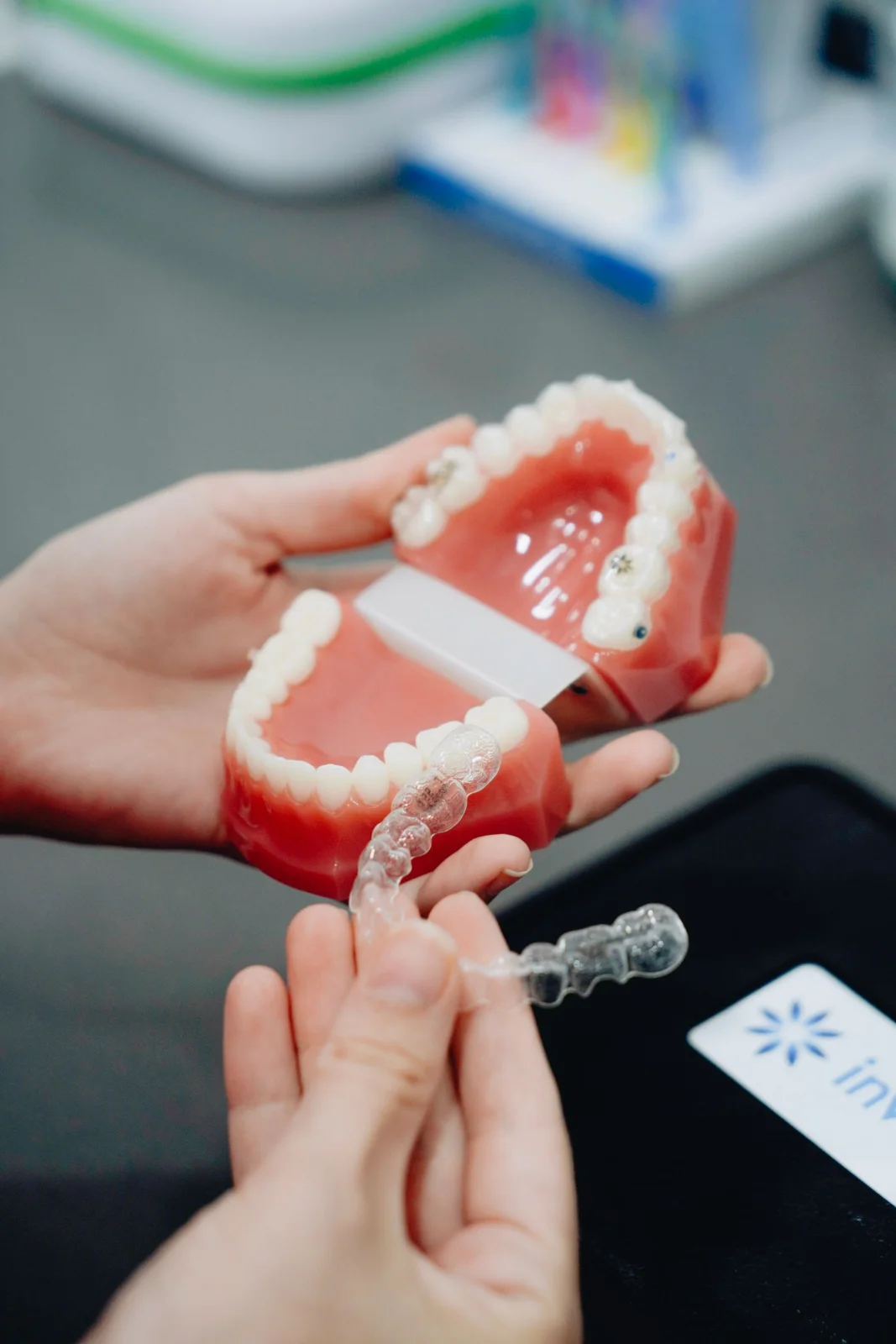
Stock photograph for illustration; not a participating clinic, practitioner, patient or treatment result. Photo: Beyza Kaplan / Pexels.
What retainers actually do after active treatment
Once braces or clear aligners have guided teeth into their new positions, the work is not finished. Teeth have a natural tendency to drift back toward where they started — a phenomenon orthodontists call relapse. An orthodontic retainer is the appliance prescribed to hold teeth in their corrected positions while the surrounding bone and soft tissue adapt to the change. Without consistent retainer wear, some degree of movement is common, which is why the retainer phase is considered part of the overall orthodontic process rather than an optional afterthought.
Understanding this purpose before your appointment helps you ask sharper questions about your specific situation, rather than leaving the consultation with vague reassurances.
The types your clinician may discuss
The Australian Society of Orthodontists identifies several categories of orthodontic appliance, and a similar breadth of options exists on the retainer side of treatment. Broadly, retainers fall into two categories:
- Removable retainers — worn for set periods each day and taken out for eating and cleaning. These include clear (Essix-style) retainers that fit like a thin mouthguard, and traditional Hawley retainers with a wire across the front teeth and an acrylic plate.
- Fixed (bonded) retainers — a thin wire bonded to the back surfaces of teeth, usually the lower front teeth, that works continuously without the patient needing to remember to wear anything.
Some patients end up with a combination: a fixed wire on the lower teeth and a removable appliance on the upper arch. The right arrangement depends on individual bite characteristics, tooth positions and patient compliance factors — all things only your treating orthodontist or dentist can assess.
See the related guide on fixed and removable retainer questions for a deeper look at how to compare these options with your practitioner.
Questions to prepare before your end-of-treatment appointment
Healthdirect Australia recommends writing down questions before a healthcare appointment and asking for explanations in plain language. Here is a focused list to bring to your retainer discussion:
About the type recommended for you
- Why are you recommending this particular retainer over the alternatives?
- What are the advantages and disadvantages of a fixed retainer versus a removable one for my bite?
- If I am given a removable retainer, how many hours per day do you recommend I wear it, and for how long?
About care and durability
- How should I clean this retainer without damaging it?
- What signs indicate the retainer needs replacing?
- How long do retainers typically last before they need to be remade?
About what happens if something goes wrong
- If a bonded wire breaks or a removable retainer cracks, how quickly do I need to contact your practice?
- Will teeth move noticeably if there is a gap in wear while I wait for a replacement?
About cost
- Is the first set of retainers included in my treatment fee, or is it a separate charge?
- What is the replacement cost if I lose or break a retainer?
- Does the quote cover future follow-up retainer checks?
The ASO’s cost checklist prompts patients to specifically ask about retainer and replacement retainer inclusions when reviewing any orthodontic quote — a useful prompt to raise before treatment even begins, not just at the end.
Understanding your individual instructions
Because this site is a referral service and not a treating practice, it cannot tell you how long you will need to wear a retainer or which type suits your teeth. That judgement belongs entirely to your registered orthodontist or dentist, based on a clinical examination of your specific case.
What this guide can tell you is that individual instructions vary considerably. Someone who had significant crowding may receive very different guidance from someone who had only mild spacing. Night-only wear versus full-day wear is a clinical call, not a universal rule. If the instructions you receive are unclear, ask for them in writing — ask the practice what written guidance it can provide.
A hypothetical scenario to illustrate what can go wrong
Note: This is a hypothetical scenario for illustration only, not a real patient account.
Imagine a person who completes eighteen months of braces and receives a removable retainer with verbal instructions. After a few months they reduce wear because nothing feels loose. A year later they notice their lower front teeth have shifted slightly. When they return, they discover the retainer no longer fits well enough to hold the correction, and a replacement is needed along with a review appointment.
The lesson here is not to self-assess compliance — the treating practitioner sets the schedule. If anything about your instructions is unclear when you leave the chair, ask before you walk out the door.
Follow-up contact and ongoing care
Retainer care does not end at the handover appointment. Most orthodontic practices schedule at least one follow-up check to confirm the retainer is fitting correctly and that teeth are stable. Ask at your final appointment:
- When should I return for a retainer check?
- What is the protocol if I have concerns between scheduled visits?
- If I move interstate or change practitioners, what records should I take with me?
For patients preparing to have this conversation for the first time, the guide on adult orthodontic consultation questions covers the broader consultation framework, while the retainer replacement consultation preparation guide is specifically useful if you have already finished treatment and need a new retainer made.
Verifying your practitioner’s registration
Orthodontists are registered dental specialists in Australia. Ahpra and the National Boards maintain publicly searchable registers of dental practitioners, including those with specialist registration. It is worth checking an individual’s registration on the Ahpra register — search by the practitioner’s personal name, not just the practice name — before committing to treatment.
Ready to ask these questions in person?
If you are looking for an orthodontic consultation in Adelaide, you can use this site to submit an enquiry; any referral depends on confirmed availability. Depending on where you are in your treatment journey, you may find the following enquiry pages useful:
- Braces Consultation Enquiries
- Clear Aligner Consultation Enquiries
- Adult Orthodontic Consultation Enquiries
Use the question lists in this guide to get the most from your first conversation with your treating practitioner.
Further reading
- Australian Society of Orthodontists — Treatment Comparison Table
- Australian Society of Orthodontists — Orthodontics Cost Checklist
- Healthdirect Australia — Questions to ask your doctor
- Ahpra — Registers of Practitioners
- Australian Dental Association — Teeth Straightening and Braces
Sources and further reading
- Professional dental information — ASO_Treatment Comparison_Table_A4_V24.pdf
- Professional dental information — 2019 09 OA Orthodontics Checklist A4 concepts_v2.pdf
- healthdirect Australia — questions to ask your doctor
- Ahpra practitioner information — Professions and Divisions.aspx
- Australian Dental Association — teeth straightening and braces
Source links provide background, not an endorsement or clinical review of this page. Read our editorial approach.