
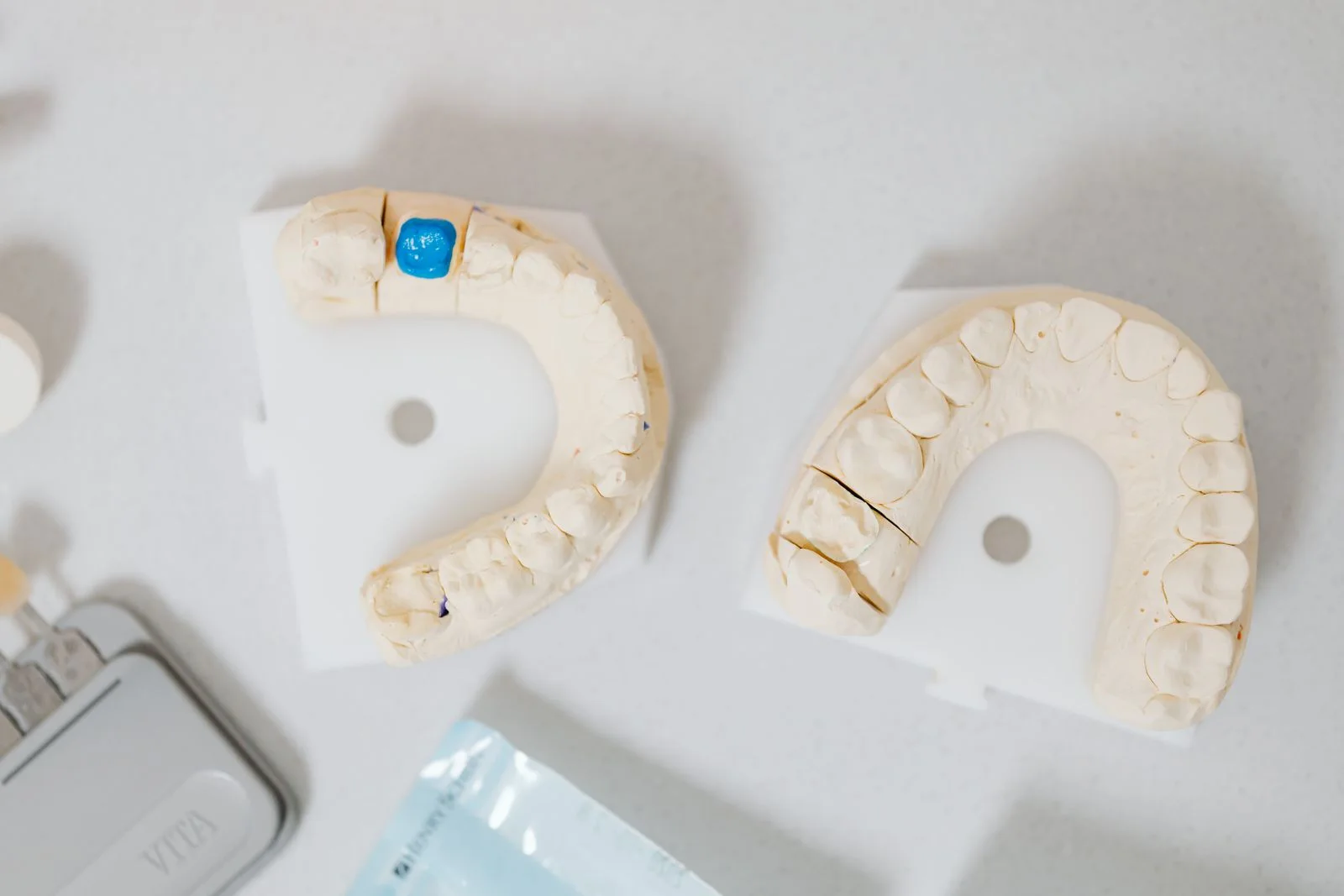
Stock photograph for illustration; not a participating clinic, practitioner, patient or treatment result. Photo: Kaboompics / Pexels.
If you are preparing for an overbite orthodontics consultation, the most useful thing you can do beforehand is clarify what the term means and write down specific questions. That way you spend appointment time on your situation rather than on definitions — and you leave with a clearer picture of what a treatment plan might involve.
What ‘overbite’ actually means — and why the term matters
In everyday speech people often use ‘overbite’ loosely to describe any bite that looks off. Clinically, the term refers to the vertical overlap of the upper front teeth over the lower front teeth. A deep overbite means that overlap is pronounced; in some cases the lower teeth are barely visible when the mouth is closed. This is different from an overjet, which describes how far the upper teeth project horizontally in front of the lower teeth — a distinction your practitioner will almost certainly draw during records and assessment.
Related bite terms you may encounter include:
- Underbite — lower front teeth sit in front of upper front teeth (see our underbite guide)
- Crossbite — upper and lower teeth on one or both sides are misaligned laterally
- Open bite — upper and lower teeth do not meet vertically in the front or back
Knowing the distinction between these terms before you arrive means you can follow the practitioner’s explanation rather than spending the consultation piecing together vocabulary.
Who assesses and manages an overbite
Orthodontics is a dental specialty concerned with teeth and bite alignment. Orthodontists are registered dental specialists; some general dentists also provide orthodontic treatment. The Australian Dental Association notes that an in-person assessment and ongoing supervision are important — that assessment is what determines what, if anything, needs to be done and which approach suits your individual situation.
You can confirm whether a practitioner holds specialist registration by searching the Ahpra public register by name. Registration details are attached to the individual, not to a business or clinic name, so search the treating practitioner directly.
This site is a referral publisher, not a treating practice. Clinical suitability and treatment decisions belong to the registered practitioner you consult.
What happens at a first consultation
A first orthodontic consultation typically involves the practitioner gathering information about your dental and medical history, examining your teeth and bite, and sometimes taking records such as X-rays, photographs or digital scans. These records inform any written treatment plan. If you have had recent dental X-rays or records, it is worth asking your referring dentist whether copies can be forwarded, as this avoids duplication.
For further context on what records are involved, see our guide on orthodontic assessment and records questions.
Appliance options the ASO recognises
The Australian Society of Orthodontists treatment comparison document names metal braces, ceramic braces, lingual braces and clear aligners as categories of orthodontic appliance. Understanding what each category means at a general level helps you ask meaningful questions, though which appliance — if any — is appropriate for your bite is a clinical decision made after assessment.
- Metal braces — fixed brackets bonded to the outer surface of teeth, connected by wires
- Ceramic braces — similar in function to metal braces but use tooth-coloured or clear brackets
- Lingual braces — fixed to the inner surface of teeth, less visible from outside
- Clear aligners — a series of removable clear plastic trays; the ADA notes that a dentist or orthodontist advises individual suitability
Asking your practitioner to explain how these options differ in the context of your specific bite gives you a basis for an informed conversation rather than a decision made from general reading.
For more on how to compare appliance categories, see Braces Consultation Enquiries and Clear Aligner Consultation Enquiries.
A written question list to bring to your consultation
Healthdirect Australia recommends writing down questions before a health appointment, asking for explanations in plain language, and asking about options, risks, benefits and any areas of uncertainty. The following list is a practical starting point. It is hypothetical in structure — your practitioner may add, reframe or answer some questions before you ask them.
About your bite specifically
- Is this a true overbite, an overjet, or both — and what is the clinical significance?
- Is any intervention recommended, or is monitoring appropriate at this stage?
- Are there any jaw, jaw joint or gum factors that need to be considered alongside the bite?
About the treatment pathway
- What appliance categories would suit my bite, and what are the differences in day-to-day experience?
- Will I need any preliminary dental work (for example, extractions or restorations) before orthodontic treatment can begin?
- Is a phased approach likely, or is single-phase treatment typical for this presentation?
About records and the written plan
- What records will you take today, and what is the purpose of each?
- When will I receive a written treatment plan, and what will it include?
- What does the quote cover — assessment, records, appliances, adjustment visits, retainers, replacement retainers?
About retention and long-term care
- What type of retention is planned after active treatment ends?
- What follow-up is involved once retention begins?
The ASO cost checklist prompts patients to ask specifically about retainers, replacement retainers and follow-up, as these are not always included in an initial quote — worth clarifying at the outset.
For adults considering orthodontics
If you are an adult considering an overbite assessment, ask the practitioner how your dental history and individual assessment affect the options they discuss. Our adult enquiry page explains how to submit a general request, with any referral subject to availability. The practitioner roles guide explains registration questions.
Preparing for the appointment practically
A few practical steps before the day:
- Bring any recent dental X-rays, referral letters or existing treatment records
- Note any symptoms you have noticed — jaw discomfort, difficulty biting, teeth wear, headaches — even if you are unsure whether they are related
- Write your question list in order of priority so the most important ones are covered if time is limited
- Ask at the end of the appointment what the next step is and what timeframe to expect
See also our guide on first orthodontic consultation preparation for a broader checklist approach.
Further reading
- Australian Society of Orthodontists — Treatment Comparison Table: https://orthodonticsaustralia.org.au/wp-content/uploads/2020/01/ASO_Treatment-Comparison_Table_A4_V24.pdf
- Australian Society of Orthodontists — Orthodontics Checklist: https://orthodonticsaustralia.org.au/wp-content/uploads/2019/11/2019-09-OA-Orthodontics-Checklist-A4-concepts_v2.pdf
- Australian Dental Association — Teeth Straightening and Braces: https://teeth.org.au/teeth-straightening-and-braces
- Healthdirect Australia — Questions to ask your doctor: https://www.healthdirect.gov.au/healthcare-and-services/general-health/questions-to-ask-your-doctor
- Ahpra Registers of Practitioners: https://www.ahpra.gov.au/Registration/Registers-of-Practitioners/Professions-and-Divisions.aspx
Sources and further reading
- Australian Dental Association — teeth straightening and braces
- Professional dental information — ASO_Treatment Comparison_Table_A4_V24.pdf
- Professional dental information — 2019 09 OA Orthodontics Checklist A4 concepts_v2.pdf
- healthdirect Australia — questions to ask your doctor
- Ahpra practitioner information — Professions and Divisions.aspx
Source links provide background, not an endorsement or clinical review of this page. Read our editorial approach.