
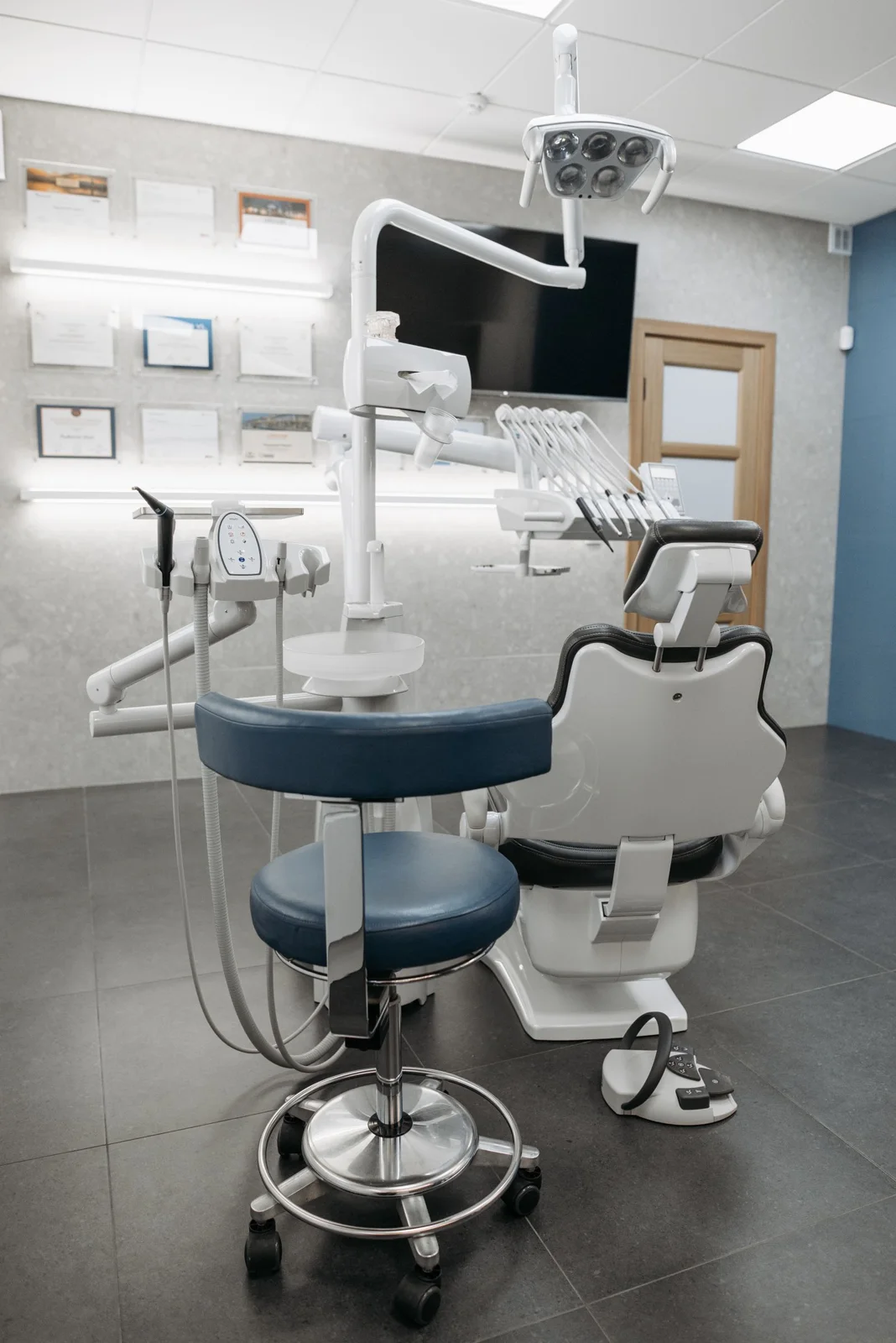
Illustrative dental consultation setting; the named appliance is not pictured. Stock photograph for illustration; not a participating clinic, practitioner, patient or treatment result. Photo: Pavel Danilyuk / Pexels.
If you have come across the term self-ligating braces while researching orthodontic options, you are probably wondering how they differ from other brace types and what questions to bring to your first appointment. The short answer: self-ligating braces use a built-in clip or door mechanism on each bracket instead of the small elastic ties used in conventional braces — but whether that distinction matters for your specific situation is a clinical question only a registered practitioner can answer after examining you.
How the term is used in orthodontic conversations
Conventional metal braces hold the archwire in place with small coloured elastic ligatures — the rubber rings most people picture when they think of braces. Self-ligating brackets replace those elastic ties with a passive or active sliding mechanism built into the bracket itself. The archwire sits inside a small metal door or clip rather than being tied down.
You will sometimes see the term split further into passive self-ligating (the bracket door holds the wire loosely) and active self-ligating (a spring-loaded clip presses against the wire). Some manufacturers also produce self-ligating ceramic brackets, which combine the tooth-coloured appearance of ceramic braces with the clip mechanism. These distinctions are worth noting so you can follow the conversation at a consultation, not because one category is inherently superior to another for every patient.
The Australian Society of Orthodontists treatment comparison lists appliance categories — metal braces, ceramic braces, lingual braces and clear aligners — as a prompt to ask practitioners about appliance differences, not as a guide to which option suits an individual.
Why appliance choice belongs in the consultation room
Marketing around orthodontic appliances can make it sound as though choosing a bracket type is like picking a smartphone model. In practice, appliance selection depends on the nature of your bite and crowding, your jaw relationship, your age, your oral hygiene capacity, and clinical factors a practitioner can only evaluate through examination and records such as X-rays and photographs.
The Australian Dental Association notes that orthodontists are dental specialists and that general dentists may also provide some orthodontic treatment, with individual suitability assessed in person. Neither a comparison article nor a referral website can determine which appliance suits you — that judgement stays with the treating practitioner.
Questions worth preparing before your appointment
Healthdirect Australia recommends writing down questions before a health appointment and asking for explanations in plain language, including about options, risks, benefits and any uncertainty involved. The following list is a starting point — treat it as a draft you refine based on your own priorities.
Hypothetical scenario (illustrative, not a real patient): Imagine someone who has researched self-ligating braces online and arrived at a consultation with no prepared questions. After a thorough clinical assessment, the practitioner recommends a treatment plan the patient did not expect. Having specific questions ready — about why a particular appliance was or was not recommended, what the adjustment schedule looks like, and how retainers work after active treatment — would help that person leave with a genuinely informed understanding rather than a shopping list of brand names.
Consultation questions to consider:
- What appliance type are you recommending for my situation, and what is the clinical reason?
- How does the bracket mechanism you are proposing affect my adjustment visits?
- Is a self-ligating bracket appropriate for my case, or would a different bracket or appliance type work better?
- If ceramic brackets are used, what are the considerations around staining or bracket strength?
- What does the full treatment plan include — records, appliances, adjustment visits, retainers and follow-up?
- What happens if a bracket or wire needs repair during treatment?
- How does my oral hygiene routine need to change, and are there areas of a fixed brace that require particular attention?
- After active treatment ends, what retention is involved and for how long?
The ASO orthodontics cost checklist also prompts questions about what is and is not included in a quoted fee — worth raising explicitly so there are no surprises about retainer replacement or additional visits.
No faster-treatment promise should be taken at face value
If you encounter a claim that a self-ligating system works faster, ask the practitioner what evidence supports that claim and whether it is relevant to the treatment proposed for you. Ask what assumptions their estimated duration depends on and how uncertainty will be explained. This guide does not review comparative clinical trials or establish a speed advantage for any system. A bracket mechanism alone is not enough information for this referral website to predict your treatment duration.
If a provider makes a specific timeline promise in advance of examining you, that is a reasonable prompt to ask the practitioner to explain what assumptions underpin the estimate and how they handle cases that move differently than expected.
Ceramic self-ligating brackets — a note on appearance
Ceramic brackets — whether self-ligating or conventional — are tooth-coloured and less visible than metal, which is a common reason adults ask about them. The ASO treatment comparison lists ceramic braces as a distinct appliance category. What it does not do is declare ceramic self-ligating brackets suitable or unsuitable for any individual. Ceramic materials vary in translucency and strength between manufacturers, and the archwire itself is typically still metallic and visible — worth understanding before expecting near-invisibility.
Adults in particular may also want to explore whether clear aligner options are worth discussing alongside fixed appliances, since both are legitimate orthodontic pathways that the practitioner can compare in the context of your records.
Verifying the practitioner you consult
Orthodontists hold specialist registration with Ahpra in addition to their dental registration. You can verify any named practitioner’s registration and specialist status through the Ahpra public register — search the individual’s name rather than the practice name. General dentists who provide orthodontic treatment are also registered with Ahpra under dental registration. This site is an independent referral service, not a treating practice, and registration checks are your own responsibility.
Preparing for a consultation in Adelaide
If you are researching self-ligating braces in Adelaide, the most productive step is an in-person consultation where a practitioner reviews your records and explains which appliance types are clinically appropriate for you, along with realistic expectations about the process. Arriving with written questions — including those about appliance mechanism, adjustment frequency, and what the written treatment plan will cover — puts you in a much better position to compare providers and make an informed decision.
Useful guides before your appointment:
- What orthodontics means before a consultation
- First orthodontic consultation preparation
- Orthodontist and dentist roles — questions to ask
- Orthodontic assessment and records questions
To connect with an orthodontic provider for a braces consultation enquiry or to explore adult orthodontic consultation options, use the referral enquiry form on this site.
Further reading
- Australian Society of Orthodontists — Treatment Comparison Table: https://orthodonticsaustralia.org.au/wp-content/uploads/2020/01/ASO_Treatment-Comparison_Table_A4_V24.pdf
- Australian Dental Association — Teeth Straightening and Braces: https://teeth.org.au/teeth-straightening-and-braces
- Healthdirect Australia — Questions to ask your doctor: https://www.healthdirect.gov.au/healthcare-and-services/general-health/questions-to-ask-your-doctor
- Ahpra Practitioner Register: https://www.ahpra.gov.au/Registration/Registers-of-Practitioners/Professions-and-Divisions.aspx
Sources and further reading
- Professional dental information — ASO_Treatment Comparison_Table_A4_V24.pdf
- Australian Dental Association — teeth straightening and braces
- healthdirect Australia — questions to ask your doctor
- Ahpra practitioner information — Professions and Divisions.aspx
- Professional dental information — 2019 09 OA Orthodontics Checklist A4 concepts_v2.pdf
Source links provide background, not an endorsement or clinical review of this page. Read our editorial approach.