
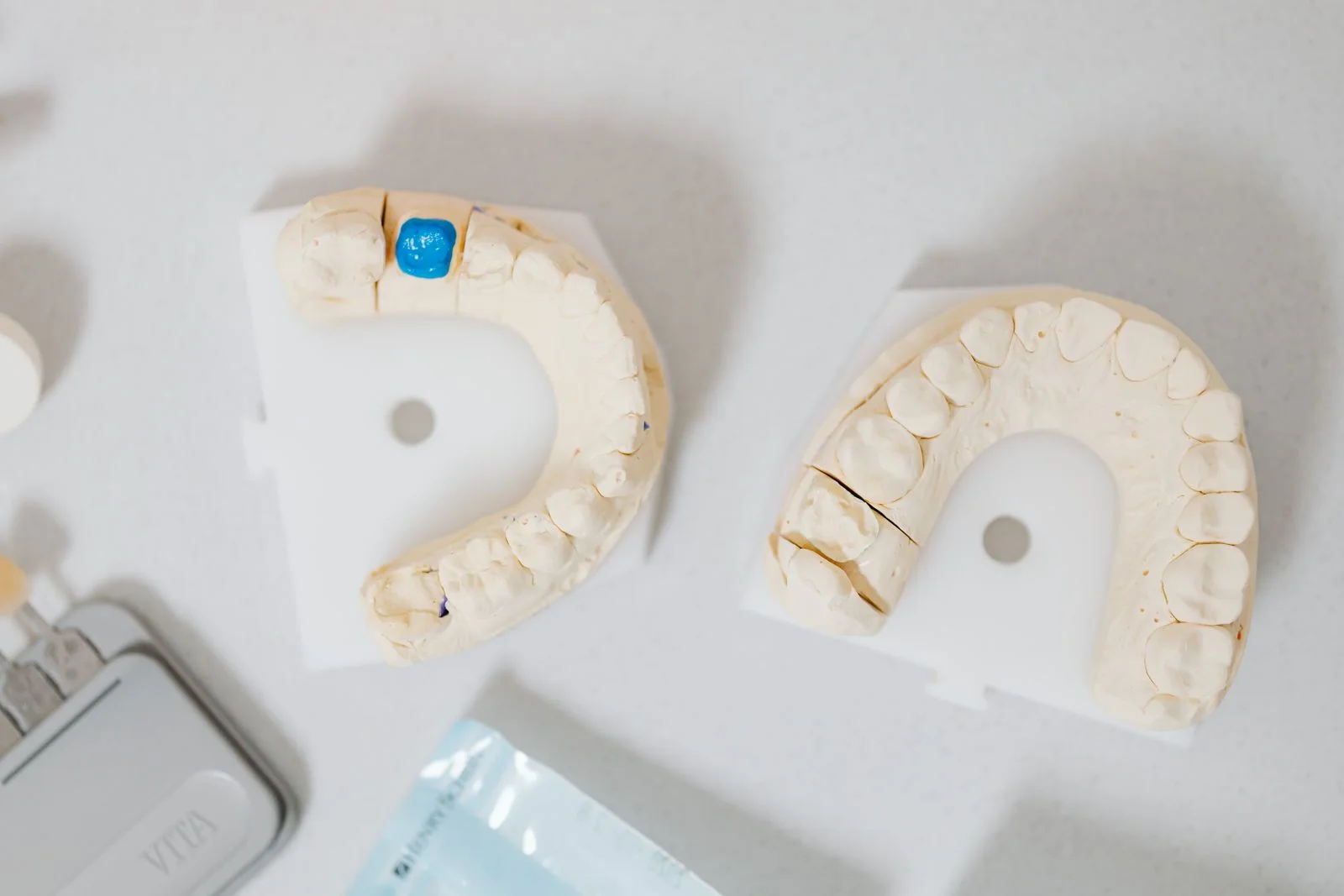
Stock photograph for illustration; not a participating clinic, practitioner, patient or treatment result. Photo: Kaboompics / Pexels.
What orthodontics actually means
Orthodontics is the branch of dentistry concerned with aligning teeth and correcting bite relationships. Before you book a consultation, understanding what that actually covers — and what it does not — saves time and helps you ask sharper questions. This guide explains core terminology, the difference between treating practitioners, and what can only be answered by a registered professional who has examined you in person.
Core terms you will encounter
Malocclusion is the clinical word for a bite that does not fit together as expected. Orthodontic treatment broadly exists to address various malocclusions. The common named types include:
- Overbite — upper front teeth cover an excessive vertical amount of the lower front teeth when biting together.
- Underbite — lower teeth sit in front of upper teeth.
- Crossbite — one or more upper teeth bite inside the lower teeth, either at the front or on the sides.
- Open bite — upper and lower front teeth do not meet when the back teeth are together.
- Crowding — insufficient arch space causes teeth to overlap or rotate.
- Spacing — gaps between teeth, sometimes from missing teeth, sometimes structural.
These terms describe observations, not automatic treatment prescriptions. Whether any of them applies to you, and to what degree, is a clinical finding made during an in-person assessment — not something a terminology guide can determine.
Appliance categories the Australian Society of Orthodontists identifies
The Australian Society of Orthodontists treatment comparison document names four broad appliance categories: metal braces, ceramic braces, lingual braces, and clear aligners. Each has different characteristics worth understanding before a consultation.
- Metal braces use metal brackets bonded to the outer surface of teeth, connected by archwires.
- Ceramic braces follow the same bracket-and-wire principle but use tooth-coloured or clear ceramic brackets, which many patients find less noticeable.
- Lingual braces are bonded to the inner (tongue-facing) surfaces of teeth, making them largely invisible from the outside.
- Clear aligners are removable, clear plastic trays changed in a series to progressively move teeth. The Australian Dental Association notes that a dentist or orthodontist advises individual suitability — aligners are not universally appropriate for every bite or tooth position.
Knowing these category names means you can ask informed questions about which appliance types a practitioner considers relevant to your situation, and why — rather than hearing those terms for the first time mid-consultation.
Who provides orthodontic treatment
This distinction matters before you book. The Australian Dental Association confirms that orthodontists are dental specialists, and that general dentists may also provide some orthodontic treatment.
An orthodontist holds a dental degree plus a postgraduate specialist qualification in orthodontics, and is registered on Ahpra’s specialist register under the dental profession. You can verify individual specialist registration through the Ahpra public register — search the named practitioner rather than a business name.
A general dentist with appropriate training may offer orthodontic treatment, particularly clear aligner therapy, within the scope of their general registration.
Neither registration category is a recommendation from this referral website. What matters for your decision is understanding who is providing your care and what qualifications and experience they hold — questions you direct to the practice, not to a lead-referral guide.
For a more detailed breakdown of how to frame questions about practitioner roles, see our related guide: Orthodontist and dentist roles — questions to ask.
What a consultation involves versus what this guide can tell you
This is the most important conceptual boundary to draw before you walk in.
A written guide can explain what an overbite is. It cannot tell you whether your overbite is clinically significant, what treatment approach suits your jaw structure, or how long any treatment might take. Those determinations require clinical records — typically photographs, X-rays, digital scans or physical impressions, and a full oral health review.
The Australian Dental Association specifically recommends in-person assessment and supervision rather than any form of unsupervised DIY orthodontics. The supervision principle reflects that tooth movement interacts with roots, bone and surrounding tissues in ways that require professional monitoring throughout treatment, not just at the start.
If you would like to understand what to expect from the records-gathering stage, the guide Orthodontic assessment and records questions and Orthodontic scans and impressions questions cover that preparation.
A hypothetical scenario: how terminology confusion plays out
This is a hypothetical example for illustration, not a real patient story.
Imagine someone in Adelaide who has looked at a provider’s website and concluded they have a “mild crossbite” based on a photo comparison. They arrive at a consultation expecting to be told which aligner brand they need. The orthodontist’s records, however, reveal that the apparent crossbite involves a skeletal component that changes the appliance conversation entirely. The person had the right word — crossbite — but lacked the clinical context to interpret it. Knowing the term helped them name their concern; it did not equip them to self-prescribe.
That gap — between knowing vocabulary and knowing what it means for your individual anatomy — is precisely why consultations exist.
Questions worth writing down before you attend
Healthdirect Australia recommends writing questions ahead of a health appointment and asking for explanations in plain language. With orthodontics, useful pre-consultation questions include:
- What type of practitioner will be conducting my assessment, and what is their registration status?
- Which appliance categories do you work with, and what factors would make one more appropriate than another for my situation?
- What records will be taken, and what do they help you determine?
- What does a written treatment plan include, and when would I receive one?
- What are the ongoing appointment requirements during treatment?
- What happens after active treatment ends — what retention involves?
The Australian Society of Orthodontists cost checklist also suggests asking specifically what a quoted fee does and does not include, covering items like assessment, records, appliances, adjustment visits, retainers, and replacement retainers.
For broader consultation preparation, see First orthodontic consultation preparation.
Ready to take the next step
If you are based in Adelaide and want to connect with a practitioner to get clinical answers to the questions this guide has raised, you can submit an enquiry through our Braces Consultation Enquiries, Clear Aligner Consultation Enquiries or Adult Orthodontic Consultation Enquiries pages. This website is a referral service — the treating practitioner you are connected with holds independent registration and is responsible for all clinical decisions.
Further reading
- Australian Dental Association — Teeth Straightening and Braces
- Australian Society of Orthodontists — Treatment Comparison Table
- Australian Society of Orthodontists — Orthodontics Checklist
- Ahpra — Registers of Practitioners
- Healthdirect Australia — Questions to ask your doctor
Sources and further reading
- Australian Dental Association — teeth straightening and braces
- Professional dental information — ASO_Treatment Comparison_Table_A4_V24.pdf
- Professional dental information — 2019 09 OA Orthodontics Checklist A4 concepts_v2.pdf
- Ahpra practitioner information — Professions and Divisions.aspx
- healthdirect Australia — questions to ask your doctor
Source links provide background, not an endorsement or clinical review of this page. Read our editorial approach.